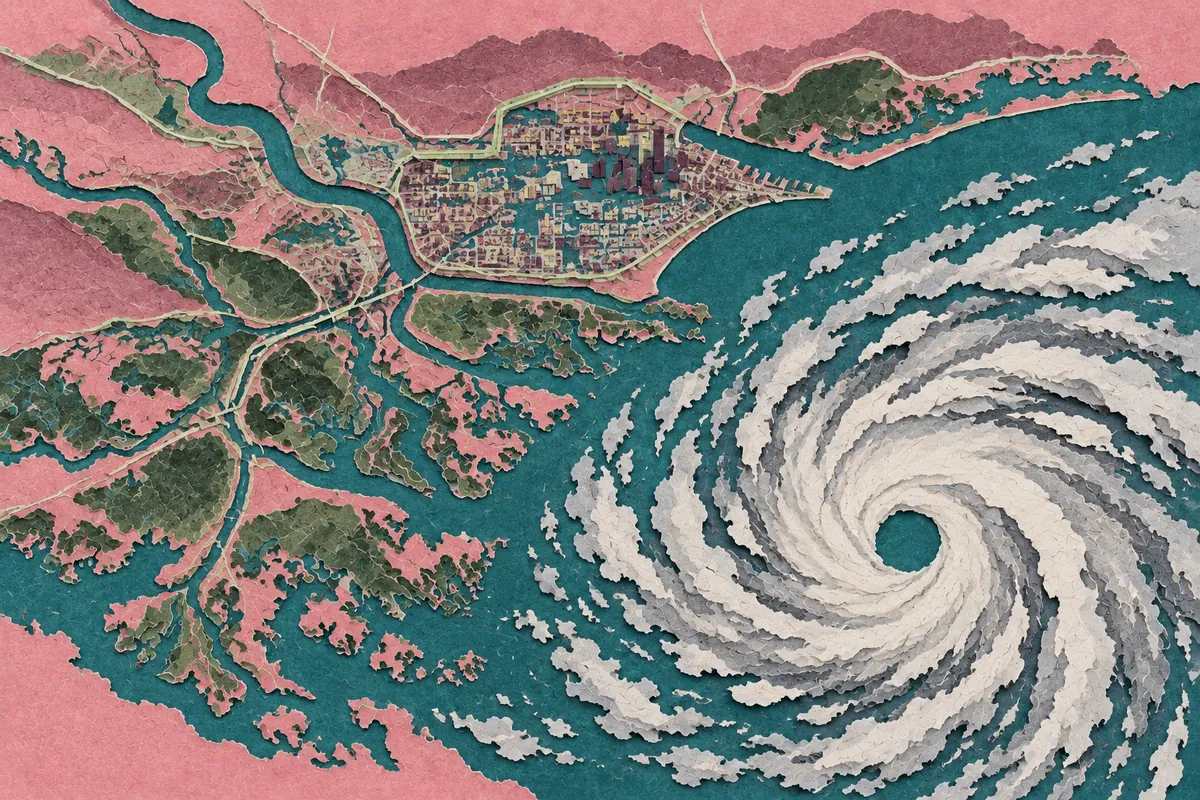
2005 Hurricane Katrina: an evacuation was ordered, so why were tens of thousands still in the city?
On 29 August 2005, Hurricane Katrina came ashore on the U.S. Gulf Coast. Storm surge broke through New Orleans' floodwalls and about 80% of the city flooded. More than 90% of residents evacuated before the storm, but the tens of thousands who remained were mostly the most vulnerable. This case study looks at the lessons in reports from the National Hurricane Center and the White House.
The death toll follows NOAA National Hurricane Center's report updated in January 2023 (1,392); NOAA revised the figures based on research by Rappaport and others, so they differ from numbers often reported in earlier years.
A hurricane is the same kind of storm as a typhoon in Asia; the lessons on storm surge and flooding also apply to typhoons and heavy rain.
01 Key facts
Based on sources
- Landfall
- Around 11:10 UTC on 29 August 2005, as a Category 3 hurricane near Buras, Louisiana; final landfall around 14:45 UTC near the Louisiana–Mississippi border Source 1
- Storm surge
- Maximum high-water mark of 27.8 ft (about 8.5 m) at Pass Christian, Mississippi Source 1
- New Orleans flooding
- About 80% of the city flooded, to depths of up to about 20 ft (about 6 m) Source 1
- Deaths
- 1,392 (520 direct, 565 indirect, 307 of indeterminate cause) Source 1
- Damage
- About $125 billion (2005 dollars) Source 1
02 What happened
Based on sources
- 28 August (day before landfall)
At a joint press conference with the Louisiana governor, the mayor ordered a mandatory evacuation of New Orleans. Source 2
- 28 August, late afternoon
The last passenger flight left the airport at 4:30 p.m.; contra-flow evacuation stopped at 5:00 p.m. because of high winds, though state officials kept urging people to leave. Source 2
- 28 August, night
The Superdome, previously a shelter only for people with special needs, opened as a "shelter of last resort" for the general public; an estimated 10,000–12,000 people were there by midnight. Source 2
- 29 August, early morning
According to NOAA, floodwall breaches along the Industrial Canal, the London Avenue Canal and the 17th Street Canal appear to have occurred during this period. Source 1
- 29 August
The hurricane made landfall; about 80% of New Orleans flooded within a day or so. Source 1
- 2 September, morning
About 15,000 people had been evacuated from the Superdome, with about 5,500 remaining. Source 3
- 3 September
Except for the ill or injured, no one was evacuated from the overcrowded Convention Center until this day. Source 3
03 Key lessons
92% left; the greatest danger was for those who remained
Based on sourcesSource 2 · Source 4
Louisiana's governor later estimated that 1.2 million people, 92% of the affected population, evacuated before the hurricane's second landfall. Still, tens of thousands, many of them the region's most vulnerable, remained in the most threatened areas. The White House review notes that people who could not leave because of health reasons or lack of transportation had great difficulty finding suitable shelter after the storm.
What you can do todayIf your household includes older people, people with limited mobility or people without a car, agree now on who will drive them and where they will go in an evacuation.
A shelter is a last resort, not a guarantee of safety
Based on sourcesSource 2 · Source 4
The Superdome, originally a shelter only for people with special needs, opened to everyone as a "shelter of last resort" the night before landfall. The White House report acknowledges that federal, state and local plans were inadequate for a catastrophe that had been anticipated for years, and that the Superdome and other shelters had vast shortcomings.
What you can do todayBring your own go-bag even to a shelter: water, food, regular medicines and copies of documents.
Levees can fail too
Based on sourcesSource 1
NOAA's report says the surge severely strained New Orleans' levee system. Most floodwall and levee breaches were caused by water overtopping them and eroding the back side, but a few breaches occurred before the water reached the top.
What you can do todayIf you live behind a levee or in a low-lying area, don't skip evacuating just because there is a levee; check your home's flood potential in advance.
Don't walk or drive into flooded roads
Based on sourcesSource 5
U.S. Ready.gov's hurricane page advises: if you live in an evacuation zone, know your zone and routes; when local officials tell you to evacuate, do so immediately; do not walk, swim or drive through flood waters. Turn Around, Don't Drown.
What you can do todayIn a typhoon or heavy rain, if a road or underpass is flooded, turn around and take another route.
04 If it happened where you live
Based on sources
Taiwan
Taiwan's National Fire Agency Disaster Prevention Hall: the principle for floods is to shelter in place or move to higher floors; people in low-lying areas should go to an evacuation shelter. When evacuation is needed, village chiefs, police or firefighters help guide residents. Source 6
Japan
Japan's Cabinet Office: in dangerous areas, older people and others who need more time start evacuating at alert level 3; everyone must leave dangerous places by alert level 4 (evacuation order). Don't wait for level 5, when safe evacuation is no longer possible. Source 7
South Korea
Korea's National Disaster and Safety Portal: people in low-lying, frequently flooded, landslide-prone areas and underground spaces should move somewhere safe; flooded roads, underpasses and bridges are closed to people and vehicles; if water starts entering a building, move immediately to higher floors or a nearby shelter. Source 8
United States
U.S. Ready.gov: know your evacuation zone and routes; evacuate immediately when told; do not walk, swim or drive through flood waters. Source 5
05 Original sources
- Tropical Cyclone Report: Hurricane Katrina (AL122005) NOAA National Hurricane Center (United States)Synoptic History; Storm surge; Casualty and Damage Statistics · Updated 4 January 2023 · Sources read 2026-10-17
- The Federal Response to Hurricane Katrina: Lessons Learned — Chapter Three: Pre-Landfall The White House (archived Bush administration site)August 28, 2005 · February 2006 · Sources read 2026-10-17
- The Federal Response to Hurricane Katrina: Lessons Learned — Chapter Four: A Week of Crisis The White House (archived Bush administration site)Superdome and Convention Center evacuation · February 2006 · Sources read 2026-10-17
- The Federal Response to Hurricane Katrina: Lessons Learned — Chapter Five: Lessons Learned The White House (archived Bush administration site)Mass Care and Housing · February 2006 · Sources read 2026-10-17
- Hurricanes FEMA Ready.gov (United States)Prepare Now; Stay Safe During · Page shows last updated 2026-09-24 · Sources read 2026-10-17
- 颱風發生時該如何疏散、避難 Disaster Prevention Hall, National Fire Agency, TaiwanEvacuation principles · Page updated 23 October 2025 · Sources read 2026-10-09
- 避難情報のポイント Cabinet Office (Disaster Management), JapanAlert levels 3, 4 and 5 · No date shown on the PDF · Sources read 2026-10-17
- 태풍 국민행동요령 National Disaster and Safety Portal, Ministry of the Interior and Safety, South KoreaWhat to do during a typhoon warning · No date shown · Sources read 2026-10-17