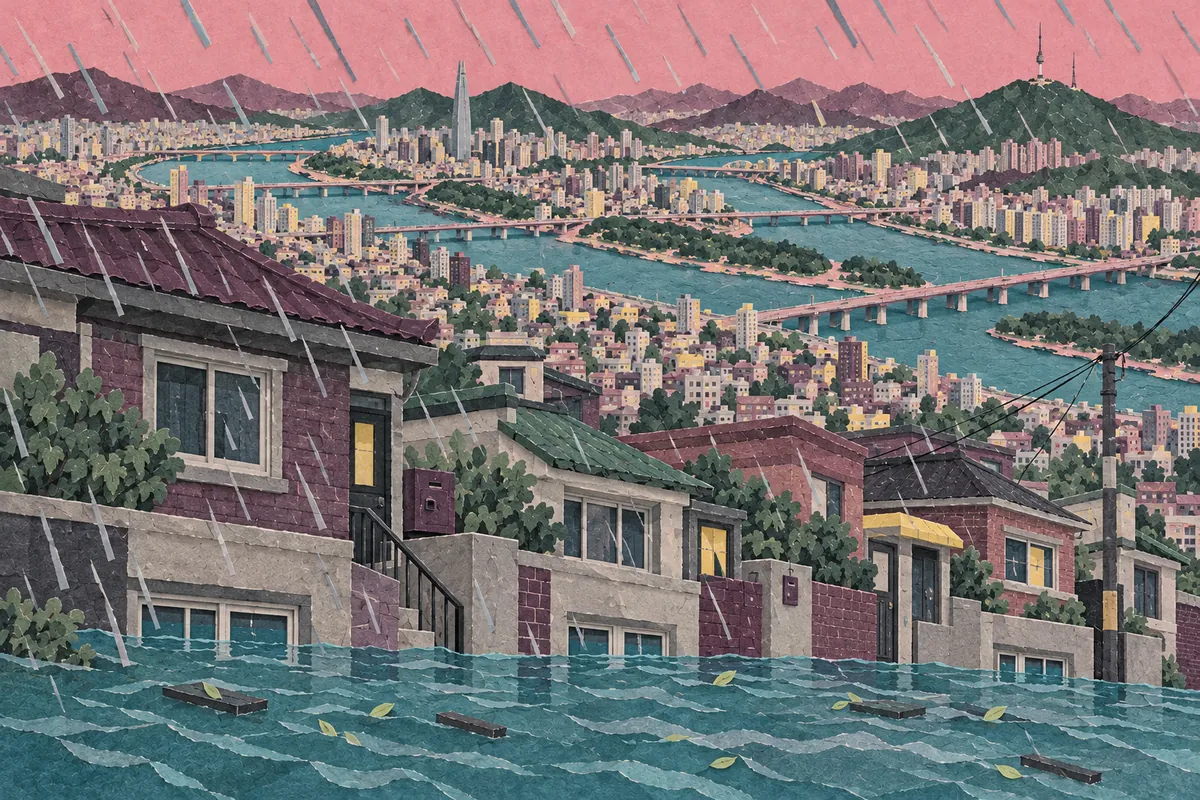
2022 Seoul floods: 141.5 mm an hour, more rain than the city was built to drain
From 8 August 2022, days of torrential rain hit Seoul and central South Korea. Peak rainfall reached 141.5 mm an hour, far above the 95 mm an hour that Seoul's drainage was designed for. More than 27,000 homes flooded, lives were lost among vulnerable households such as those in semi-basement homes, and the government reviewed its urban flood standards.
We did not find a final official death toll published by the Korean government, so this page does not give a death count.
01 Key facts
Based on sources
- Period
- Concentrated heavy rain in central Korea from 8 to 17 August 2022 Source 1
- Peak hourly rainfall
- 141.5 mm an hour; Seoul's drainage design standard is 95 mm an hour Source 2
- Flooded homes
- 27,262 households flooded in low-lying urban areas of Seoul, Gyeonggi and elsewhere Source 1
- Property damage
- 315.5 billion won; 16,842 public facilities damaged Source 1
- Semi-basement homes
- Seoul has an estimated 202,741 semi-basement homes, about 5% of all households (end of 2021) Source 2
02 What happened
Based on sources
- 8 August 2022
Record rain hit Seoul and nearby areas, peaking at 141.5 mm an hour. Source 1 · Source 2
- 8–17 August
Concentrated heavy rain continued across central Korea. Source 1
- Afterwards
Seoul announced measures for semi-basement flooding: support for tenants, small flood-prevention devices such as flood barriers, and raising its design standard to 100–110 mm an hour. Source 2
- 8 September 2022
The government announced a 790.5 billion won recovery plan and formed a task force of 13 agencies, including the interior, environment and land ministries, to look at deep rainwater tunnels, care for vulnerable households and higher disaster standards. Source 1
03 Key lessons
Rain can exceed what a city is designed for
Based on sourcesSource 2
The Seoul Institute notes that the peak rainfall of 141.5 mm an hour far exceeded the 95 mm an hour design standard of Seoul's drainage. Drainage systems have limits, and cities flood too.
What you can do todayWhen a heavy rain warning is issued, people in low-lying areas or underground spaces should move to higher ground before water comes in.
Underground and semi-basement spaces are the most dangerous
Based on sourcesSource 1 · Source 3
The government's recovery plan said it would draw up tailored measures for vulnerable households, such as semi-basement and tiny single-room homes, where lives were lost in the rain. Korea's National Disaster and Safety Portal also advises moving immediately to higher floors or a nearby shelter as soon as water starts entering a building.
What you can do todayIf you live in a basement or semi-basement, leave and go up as soon as water starts seeping in. Don't stop to save furniture.
Flooding doesn't only happen in the countryside
Based on sourcesSource 1
In this rain, 27,262 households flooded in low-lying urban areas of Seoul, Gyeonggi and elsewhere, and 16,842 public facilities were damaged.
What you can do todayCheck your home and workplace on your government's flood-potential map so you know whether you are in a low-lying area.
04 If it happened where you live
Based on sources
Taiwan
Taiwan's National Fire Agency Disaster Prevention Hall: the principle for floods is to shelter in place or move to higher floors; people in low-lying areas should go to an evacuation shelter. When evacuation is needed, village chiefs, police or firefighters help guide residents. Source 4
Japan
Japan's Cabinet Office: in dangerous areas, older people and others who need more time start evacuating at alert level 3; everyone must leave dangerous places by alert level 4 (evacuation order). Don't wait for level 5, when safe evacuation is no longer possible. Source 5
South Korea
Korea's National Disaster and Safety Portal: people in low-lying, frequently flooded areas and underground spaces should move somewhere safe; flooded roads and underpasses are closed to people and vehicles; if water starts entering a building, move immediately to higher floors or a nearby shelter. Source 3
United States
U.S. Ready.gov: know your evacuation zone and routes; evacuate immediately when told; do not walk, swim or drive through flood waters. Source 6
05 Original sources
- 8월 서울·경기 등 집중호우 피해 복구비 7905억원 투입 Korea Policy Briefing (Government of South Korea)Full text · 8 September 2022 · Sources read 2026-10-17
- 서울 반지하주택, 반복되는 침수피해 해소 위해 일관되고 지속적인 정책추진 필요 The Seoul Institute (research institute funded by the Seoul Metropolitan Government)Report summary · 11 July 2023 · Sources read 2026-10-17
- 태풍 국민행동요령 National Disaster and Safety Portal, Ministry of the Interior and Safety, South KoreaWhat to do during a typhoon warning · No date shown · Sources read 2026-10-17
- 颱風發生時該如何疏散、避難 Disaster Prevention Hall, National Fire Agency, TaiwanEvacuation principles · Page updated 23 October 2025 · Sources read 2026-10-09
- 避難情報のポイント Cabinet Office (Disaster Management), JapanAlert levels 3, 4 and 5 · No date shown on the PDF · Sources read 2026-10-17
- Hurricanes FEMA Ready.gov (United States)Prepare Now; Stay Safe During · Page shows last updated 2026-09-24 · Sources read 2026-10-17