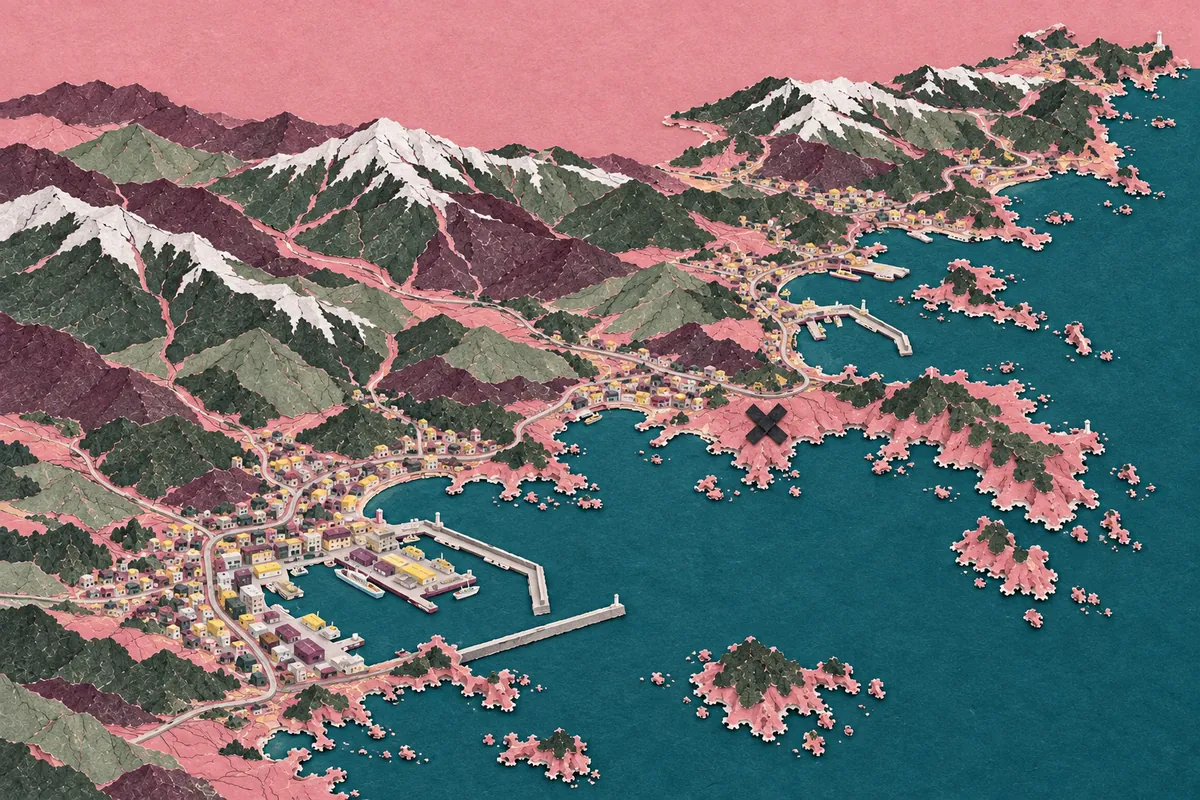
2024 Noto Peninsula earthquake: a New Year's Day quake, winter shelters and a cut-off peninsula
At 4:10 p.m. on 1 January 2024, a magnitude 7.6 earthquake struck the Noto region of Ishikawa Prefecture, with intensity 7 in Wajima and Shika. A tsunami and a major fire followed. Broken roads left communities on the peninsula cut off, and many people fell ill in shelters in the depths of winter. This case study draws on Japan's Fire and Disaster Management white paper.
Casualty and housing figures follow the statistics as of 21 November 2024 cited in Japan's Fire and Disaster Management white paper and may since have been updated.
01 Key facts
Based on sources
- Time
- 16:10 on 1 January 2024 (Japan time) Source 1
- Magnitude and intensity
- Magnitude 7.6; intensity 7 in Wajima and Shika, Ishikawa Prefecture Source 1
- Tsunami
- Inundation heights of 4 m or more in Suzu and Noto; runup of 5.9 m in Joetsu, Niigata Source 1
- Casualties
- 450 dead or missing (including 167 in Wajima and 137 in Suzu), 1,344 injured (as of 21 November 2024) Source 1
- Homes
- 6,436 completely destroyed; 132,423 half destroyed or partially damaged Source 1
- Fires
- 17 fires; about 240 buildings over about 49,000 m² burned in Kawai-machi, Wajima Source 1
02 What happened
Based on sources
- 16:06
An earthquake with maximum intensity upper 5 struck first, and the Fire and Disaster Management Agency set up its disaster headquarters. Source 1
- 16:10
The magnitude 7.6 main shock struck, with intensity 7 in Wajima and Shika. Source 1
- From 16:11
The government set up an office at the Prime Minister's residence; a specified disaster headquarters followed at 17:30 and was upgraded to an extreme disaster headquarters at 22:40. Source 1
- 2 January
The large fire in Wajima stopped spreading; fire helicopters confirmed by reconnaissance that aerial firefighting was not needed. Source 1
- 72 and 120 hours after
Rescue teams were still pulling trapped people from collapsed homes in Wajima (after 72 hours) and Suzu (after more than 120 hours). Source 1
- 1 January – 21 February
Over 52 days, Emergency Fire Response Teams deployed a cumulative total of about 17,000 units and 59,000 personnel. Source 1
03 Key lessons
A winter shelter is a risk in itself
Based on sourcesSource 1
The white paper notes that the disaster struck in the depths of winter and many people fell ill in shelters; power and water were out over a wide area, and patients and residents of hospitals and care facilities had to be moved to areas where utilities were stable.
What you can do todayAdjust your go-bag for the season: in winter add warm clothes, a blanket and heat packs, along with your daily medicines.
People were rescued even after 72 hours
Based on sourcesSource 1
Amid continuing aftershocks, rescue teams pulled trapped people from collapsed homes in Wajima more than 72 hours after the quake and in Suzu more than 120 hours after.
What you can do todayKeep a whistle and flashlight by your bed; if trapped, use the whistle or tap to make noise so rescuers can find you.
Peninsulas and mountain areas can be cut off
Based on sourcesSource 1
Roads and transport were badly damaged, so rescue teams reached Wajima and Suzu by Self-Defense Force helicopters and Japan Coast Guard ships; fire helicopters also rescued people from isolated communities and carried supplies.
What you can do todayIf you live in the mountains, by the sea or anywhere with few access roads, store more than three days of supplies and plan how to stay in touch if roads are cut.
Fire after the earthquake
Based on sourcesSource 1
After the quake, 17 fires broke out in Ishikawa, Niigata and Toyama; in Kawai-machi, Wajima, about 240 buildings over about 49,000 m² burned.
What you can do todayOnce the shaking stops, check for fire sources and turn off the gas before you evacuate; install residential smoke alarms.
04 If it happened where you live
Based on sources
Taiwan
The Central Weather Administration's interactive earthquake guide is built on Drop, Cover and Hold On, with separate advice for indoors, outdoors and in vehicles; if you are in bed, stay there, turn face down and protect your head and neck with a pillow. Source 2
Japan
Japan Meteorological Agency: when you see or hear an Earthquake Early Warning or feel shaking, alert the people around you and, depending on the situation, stay calm and protect yourself first; strengthen your home and secure furniture in advance. Source 3
South Korea
Gyeongsangbuk-do Disaster and Safety Countermeasures Headquarters: while shaking, get under a table and hold its legs; once it stops, turn off power and gas, open the door to secure an exit, take the stairs (not the elevator) to an open space such as a park, and do not drive. Source 4
United States
U.S. Ready.gov: Drop, Cover, then Hold On; secure bookcases, refrigerators, water heaters, televisions and objects hanging on walls in advance. Source 5
05 Original sources
- 令和6年版 消防白書 特集1 1.令和6年能登半島地震への対応 Fire and Disaster Management Agency, Japan(1) Earthquake overview; (2) Damage; FDMA response; Emergency Fire Response Teams · 2024 edition (damage figures as of 21 November 2024) · Sources read 2026-10-17
- 互動式地震避難指南 Central Weather Administration, TaiwanCore principle; indoors: in bed · No date shown · Sources read 2026-10-09
- 緊急地震速報を見聞きしたときは Japan Meteorological AgencyIntroduction · No date shown · Sources read 2026-10-17
- 지진대피요령 Gyeongsangbuk-do Disaster and Safety Countermeasures Headquarters, South KoreaWhile shaking / when shaking stops / by location · No date shown · Sources read 2026-10-17
- Earthquakes FEMA Ready.gov (United States)Prepare / During: Drop, Cover, then Hold On · No date shown in the content read · Sources read 2026-10-17