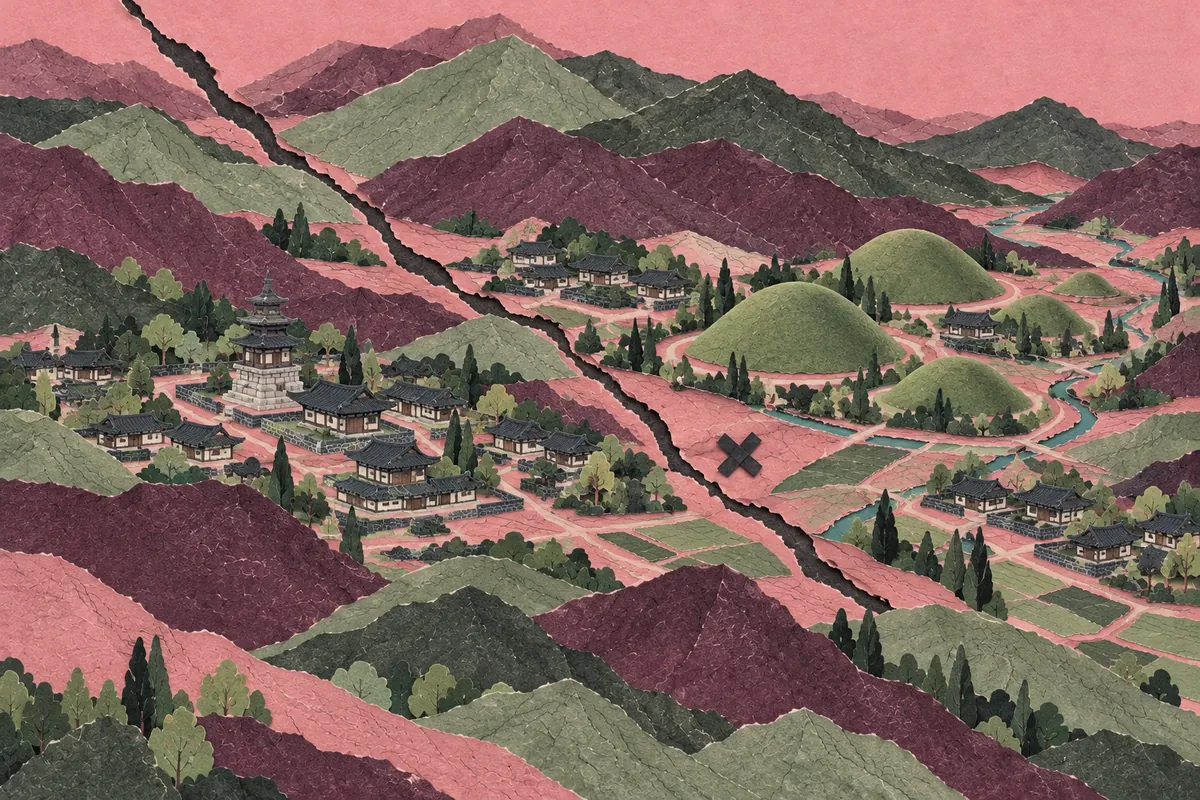
2016 Gyeongju earthquake: late alerts, a crashed website, and people unsure what to do
On the evening of 12 September 2016, earthquakes of magnitude 5.1 and 5.8 struck Gyeongju in North Gyeongsang Province, the largest since the Korea Meteorological Administration began its observations. In a later review, the Korean government acknowledged that disaster text alerts were too slow, its website went down and people did not know how to act. This case study looks at the government's records and what changed.
01 Key facts
Based on sources
- Time
- Foreshock around 19:44 (M5.1) and main shock around 20:32 (M5.8) on 12 September 2016 (Korea time) Source 1
- Epicenter
- About 8.7 km south-southwest of Gyeongju, North Gyeongsang Province Source 1
- Magnitude
- 5.8, the largest since the Korea Meteorological Administration began weather reporting Source 1
- Cause
- Estimated to be horizontal movement on a fault in the Yangsan fault zone around Gyeongju Source 1
- Damage
- 9,319 cases of human and property damage (Ministry of the Interior and Safety, as of 25 September 2016) Source 1
- Aftershocks
- More than 450 by 4 October 2016 Source 2
02 What happened
Based on sources
- 12 September, 19:44
Magnitude 5.1 foreshock. Source 1
- 12 September, 20:32
Magnitude 5.8 main shock. Source 1
- Afterwards
Gyeongju was declared a special disaster area. Source 3
- 4 October
A Ministry of Public Safety and Security briefing acknowledged that the main criticisms were that disaster texts came too late, the website crashed, and people did not know what to do. Source 2
- 4 October
Improvements were announced: earthquake disaster texts would be handled solely by the Korea Meteorological Administration, its earthquake early warning system would be linked to the emergency text system from December, and from the second half of the next year it would send texts directly; the website's servers were expanded twice. Source 2
- Afterwards
The government drew up standardized earthquake action guidelines by location and stage and revised its standard earthquake crisis management manual. Source 2 · Source 3
03 Key lessons
An alert can arrive later than the shaking
Based on sourcesSource 2
At the time of the Gyeongju earthquake, earthquake information went from the Korea Meteorological Administration to the Ministry of Public Safety and Security, which then sent the emergency text, and people complained that it came too late. The government later gave the job directly to the meteorological agency that observes the earthquake, to cut the delay.
What you can do todayDon't wait for a phone alert: when you feel shaking, Drop, Cover and Hold On first.
If you haven't learned it, you won't know what to do
Based on sourcesSource 2
The government acknowledged that many people said they knew they should act but didn't know how. After consulting experts, it created unified guidelines by location and stage, produced leaflets, booklets and videos, and expanded education and drills.
What you can do todayRead now how to take cover at home, at work and in a car, and practice it once.
Official websites can crash when you need them most
Based on sourcesSource 2
After the earthquake, the Ministry of Public Safety and Security website became inaccessible; servers were later expanded twice and the content made lighter.
What you can do todayKeep several ways to get information: phone alerts, radio, TV and a family contact plan, not just one website.
Aftershocks go on for a long time
Based on sourcesSource 2
By 4 October, the Gyeongju earthquake had produced more than 450 aftershocks.
What you can do todayFor several days after a big quake, keep your go-bag by the door and your shoes and flashlight by the bed at night.
04 If it happened where you live
Based on sources
Taiwan
The Central Weather Administration's interactive earthquake guide is built on Drop, Cover and Hold On, with separate advice for indoors, outdoors and in vehicles; if you are in bed, stay there, turn face down and protect your head and neck with a pillow. Source 4
Japan
Japan Meteorological Agency: when you see or hear an Earthquake Early Warning or feel shaking, alert the people around you and, depending on the situation, stay calm and protect yourself first; strengthen your home and secure furniture in advance. Source 5
South Korea
Gyeongsangbuk-do Disaster and Safety Countermeasures Headquarters: while shaking, get under a table and hold its legs; once it stops, turn off power and gas, open the door to secure an exit, take the stairs (not the elevator) to an open space such as a park, and do not drive. Source 6
United States
U.S. Ready.gov: Drop, Cover, then Hold On; secure bookcases, refrigerators, water heaters, televisions and objects hanging on walls in advance. Source 7
05 Original sources
- 지진사례 National Disaster Management Research Institute, Ministry of the Interior and Safety, South Korea9.12 earthquake · No date shown · Sources read 2026-10-17
- 지진관련 향후대책 등 Ministry of Public Safety and Security, South Korea (via Korea Policy Briefing)Briefing and Q&A by the Disaster Management Office director · 4 October 2016 · Sources read 2026-10-17
- 9.12지진 Ministry of the Interior and Safety, South KoreaTimeline of the earthquake and follow-up measures · No date shown on the PDF · Sources read 2026-10-17
- 互動式地震避難指南 Central Weather Administration, TaiwanCore principle; indoors: in bed · No date shown · Sources read 2026-10-09
- 緊急地震速報を見聞きしたときは Japan Meteorological AgencyIntroduction · No date shown · Sources read 2026-10-17
- 지진대피요령 Gyeongsangbuk-do Disaster and Safety Countermeasures Headquarters, South KoreaWhile shaking / when shaking stops / by location · No date shown · Sources read 2026-10-17
- Earthquakes FEMA Ready.gov (United States)Prepare / During: Drop, Cover, then Hold On · No date shown in the content read · Sources read 2026-10-17