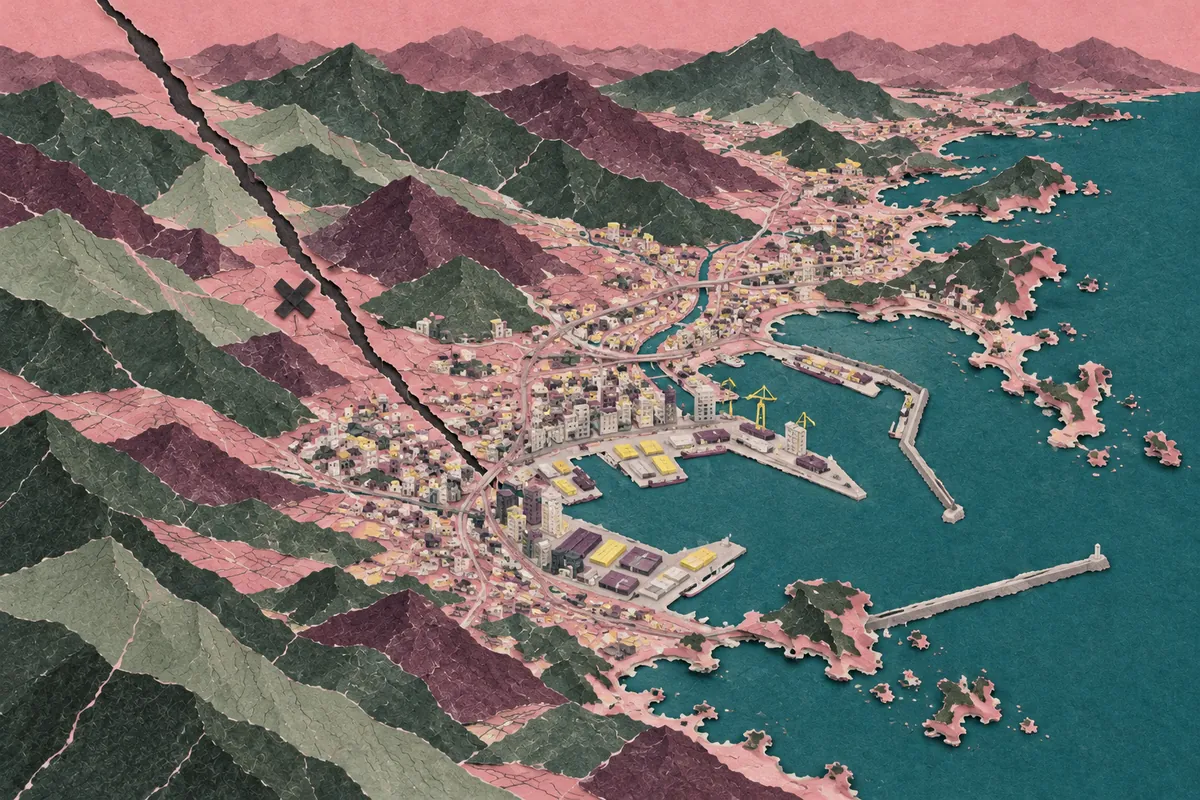
2017 Pohang earthquake: a quake on the eve of the national exam, and an official finding that it was triggered
On the afternoon of 15 November 2017, a magnitude 5.4 earthquake struck Pohang in North Gyeongsang Province, South Korea. The national university entrance exam set for the next day was postponed by a week, buildings with open ground-floor parking were visibly damaged, and soil liquefaction occurred. A government research commission later concluded that the quake was triggered by a nearby geothermal power project.
This page cites only the conclusion of the Korean government research commission and does not comment on later questions of liability or legal proceedings.
01 Key facts
Based on sources
- Time
- Around 14:29 on 15 November 2017 (Korea time) Source 1
- Epicenter
- About 8 km north of Buk-gu, Pohang, North Gyeongsang Province Source 1
- Magnitude
- 5.4, second only to the 12 September 2016 Gyeongju earthquake (5.8) Source 1
- Damage
- 1,945 people displaced; property damage of about 85.022 billion won (Ministry of the Interior and Safety, 2017 Disaster Yearbook) Source 1
- Cause
- A government research commission (2019) concluded it was triggered by fluid injection at a geothermal power project Source 4
02 What happened
Based on sources
- 2017-11-15 14:29
A magnitude 5.4 earthquake struck about 8 km north of Buk-gu, Pohang. Source 1
- 2017-11-15
The Ministry of Education announced that the College Scholastic Ability Test, scheduled for the 16th, would be postponed by one week to the 23rd. Source 2
- From 2017-11-19
The National Disaster Management Research Institute (Ministry of the Interior and Safety) and the Korea Meteorological Administration began a joint investigation of suspected liquefaction. Source 3
- 2017-12-01
Interim liquefaction findings: 17 suspected cases had been reported, and 5 of 10 borehole sites were classed as "ground where liquefaction can occur". Source 3
- 2018-08
The Ministry of Land, Infrastructure and Transport moved to amend the law so that design and supervision of piloti buildings (open ground floor) of three or more stories require cooperation from relevant technical experts (public notice 31 July – 9 September 2018). Source 5
- 2019-03-20
The government research commission reported that pore pressure spreading from water injected by the geothermal project gradually induced micro-earthquakes and finally triggered the Pohang earthquake on a fault that was already close to a critical stress state. Source 4
03 Key lessons
Take extra care with open ground-floor buildings
Based on sourcesSource 5
Korea's Ministry of Land, Infrastructure and Transport noted that piloti buildings (with only columns on the ground floor, often used for parking) suffered much of the damage in the Pohang earthquake, and pointed to poor design and poor construction. It therefore moved to require cooperation from relevant technical experts in the design and supervision of piloti buildings of three or more stories.
What you can do todayIf you live in a building with open ground-floor parking, ask the building management whether a seismic assessment has been done; after a quake, check columns and walls for cracks first.
The ground itself can "liquefy"
Based on sourcesSource 3
The Ministry of the Interior and Safety's interim investigation received 17 reports of suspected liquefaction, and 5 of 10 borehole sites were classed as ground where liquefaction can occur. It concluded that the quake did cause natural liquefaction but not at a worrying level, and widened the analysis using about 3,000 existing boreholes from development projects.
What you can do todayCheck your local soil-liquefaction potential map; if your home is in a medium- or high-potential zone, inspect the building more carefully.
The day after a big quake, the ground can shake again
Based on sourcesSource 2
The Ministry of Education postponed the exam due the next day by a week, weighing student safety and fairness; one reason was that after the Gyeongju earthquake the previous year, an aftershock had struck the following day.
What you can do todayFor several days after a big quake, don't go back into visibly damaged buildings; keep your go-bag by the door.
04 If it happened where you live
Based on sources
Taiwan
The Central Weather Administration's interactive earthquake guide is built on Drop, Cover and Hold On, with separate advice for indoors, outdoors and in vehicles; if you are in bed, stay there, turn face down and protect your head and neck with a pillow. Source 6
Japan
Japan Meteorological Agency: when you see or hear an Earthquake Early Warning or feel shaking, alert the people around you and, depending on the situation, stay calm and protect yourself first; strengthen your home and secure furniture in advance. Source 7
South Korea
Gyeongsangbuk-do Disaster and Safety Countermeasures Headquarters: while shaking, get under a table and hold its legs; once it stops, turn off power and gas, open the door to secure an exit, take the stairs (not the elevator) to an open space such as a park, and do not drive. Source 8
United States
U.S. Ready.gov: Drop, Cover, then Hold On; secure bookcases, refrigerators, water heaters, televisions and objects hanging on walls in advance. Source 9
05 Original sources
- 지진사례 National Disaster Management Research Institute, Ministry of the Interior and Safety, South KoreaPohang earthquake; 9.12 earthquake · No date shown · Sources read 2026-10-17
- [포항 지진] 수능 23일로 1주일 연기 Korea Policy Briefing (korea.kr)Ministry of Education decision to postpone the exam · 15 November 2017 · Sources read 2026-10-17
- 11.15. 포항 지진 관련 행안부 브리핑 Ministry of the Interior and Safety, South Korea (via Korea Policy Briefing)Interim liquefaction findings · 1 December 2017 · Sources read 2026-10-17
- 포항지진과 지열발전의 연관성에 관한 정부조사연구단 요약보고서 Korean Government Commission (government-commissioned)Conclusion of the summary report · 20 March 2019 · Sources read 2026-10-17
- 필로티 건축물 구조안전 강화 건축법령 개정 관련(참고자료) Ministry of Land, Infrastructure and Transport, South KoreaFull text (1 page) · 20 August 2018 · Sources read 2026-10-17
- 互動式地震避難指南 Central Weather Administration, TaiwanCore principle; indoors: in bed · No date shown · Sources read 2026-10-09
- 緊急地震速報を見聞きしたときは Japan Meteorological AgencyIntroduction · No date shown · Sources read 2026-10-17
- 지진대피요령 Gyeongsangbuk-do Disaster and Safety Countermeasures Headquarters, South KoreaWhile shaking / when shaking stops / by location · No date shown · Sources read 2026-10-17
- Earthquakes FEMA Ready.gov (United States)Prepare / During: Drop, Cover, then Hold On · No date shown in the content read · Sources read 2026-10-17