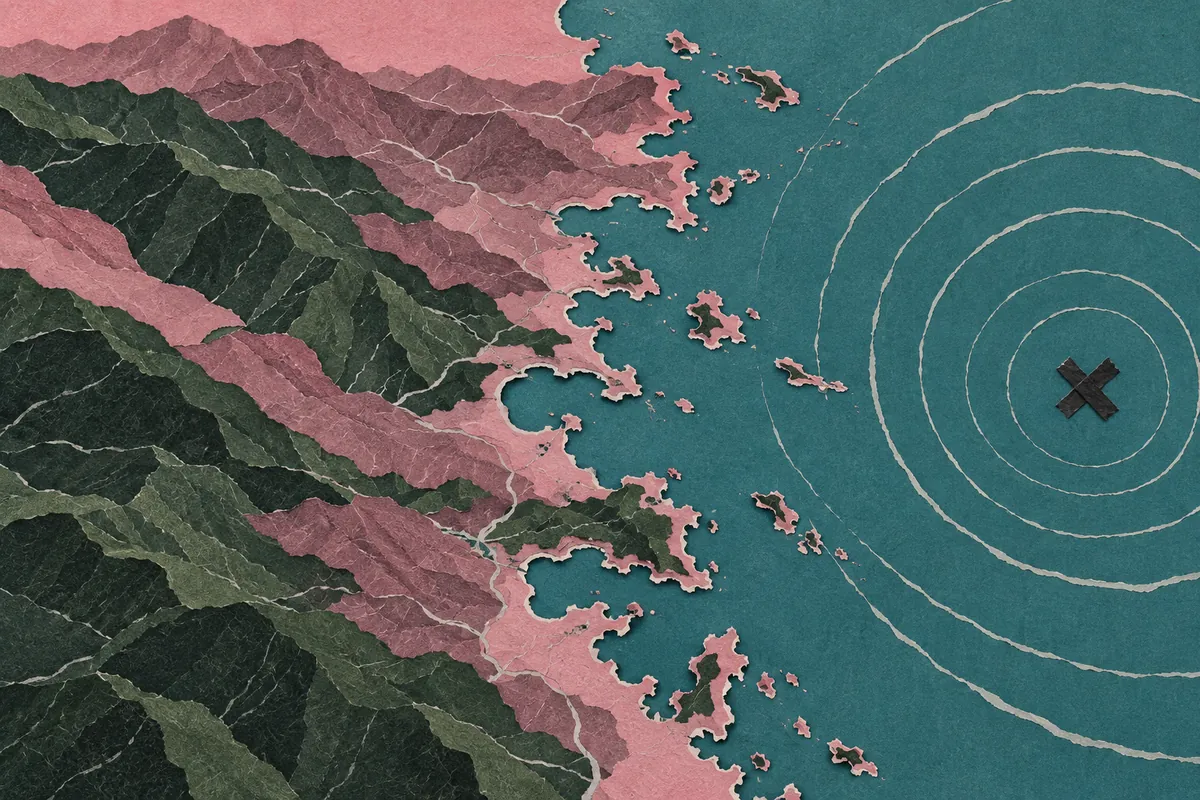
2011 Tohoku earthquake and tsunami: don't wait for the wave-height number, head for high ground
On 11 March 2011, a magnitude 9.0 earthquake struck off northeastern Japan and the tsunami that followed caused enormous loss of life. The first tsunami height forecast later proved too low, while in Kamaishi, Iwate, where people had long practiced "everyone runs on their own after a quake," almost all schoolchildren evacuated safely. This case study looks at the lessons in Japan's official records.
This page focuses on earthquake and tsunami evacuation; the Fukushima Daiichi nuclear accident is outside its scope.
Casualty figures follow the Fire and Disaster Management Agency's report No. 165 (as of 1 March 2025) and may differ from sources counted at other times.
01 Key facts
Based on sources
- Time
- 11 March 2011, 14:46 (Japan time) Source 1
- Hypocenter
- Off the Sanriku coast (38°06.2′N, 142°51.6′E), depth 24 km Source 1
- Magnitude and intensity
- Moment magnitude 9.0; maximum Japanese seismic intensity 7 Source 1
- Casualties
- 19,782 dead (including disaster-related deaths), 2,550 missing, 6,242 injured Source 3
- Homes
- 122,053 completely destroyed, 284,074 half destroyed Source 3
02 What happened
Based on sources
- 14:46
The earthquake struck. Source 1
- 8.6 s after detection
The Japan Meteorological Agency issued an Earthquake Early Warning 8.6 seconds after first detecting seismic waves. Source 2
- 14:49
Three minutes after the quake, a major tsunami warning was issued for the Iwate, Miyagi and Fukushima coasts. Forecast heights at the time: Iwate 3 m, Miyagi 6 m, Fukushima 3 m. Source 2
- 15:14
Forecasts were raised: Miyagi to "10 m or more", Iwate and Fukushima to 6 m. Source 2
- 15:30
Iwate and Fukushima were also raised to "10 m or more". Source 2
- 15:51
The Soma station in Fukushima recorded a maximum wave of 9.3 m or more; the instruments were damaged by the tsunami, so the actual wave may have been higher. Source 2
- 12 March, 03:20
Tsunami warnings or advisories were in effect for every coast in Japan. Source 2
03 Key lessons
The first number may be lower than reality
Based on sourcesSource 2 · Source 5
The first warning, three minutes after the quake, forecast 6 m for Miyagi and 3 m for Iwate and Fukushima; within 45 minutes all three were raised to "10 m or more". Japan's Cabinet Office white paper notes that the first warning underestimated the magnitude and that seismic waves exceeded the range of broadband seismometers, delaying updates. From 7 March 2013, the Japan Meteorological Agency changed its system: for a giant earthquake whose size may be underestimated, the first warning now says "huge" (kyodai) or "high" (takai) to signal an emergency, instead of giving a number first.
What you can do todayIf you hear a major tsunami warning or see the word "huge", don't wait for a precise height. Move to high ground or inland right away.
Kamaishi: "tsunami tendenko" and three evacuation principles
Based on sourcesSource 4
Kamaishi in Iwate had long taught "tsunami tendenko": if you feel strong shaking by the sea, don't worry about your family, each person runs to high ground as fast as possible to save their own life. It also stressed three principles: don't trust the hazard estimates, do your very best, and be the first to evacuate. When the earthquake struck, more than 90% of Kamaishi Elementary School's pupils had already gone home, yet all of them evacuated safely. Some helped a grandmother escape; others saw the force of the tsunami and, with people around them, ran to ground higher than the designated evacuation site. The white paper also records that five schoolchildren who were not at school died, and that one school staff member was still missing when it was written.
What you can do todayAgree with your family in advance: when strong shaking starts, each person heads for high ground and you meet at an agreed spot. Don't turn back to look for each other.
A tsunami is more than one wave; don't go back until the warning is lifted
Based on sourcesSource 2 · Source 6
The maximum wave at Soma came at 15:51, more than an hour after the earthquake; at Oarai in Ibaraki, the first wave arrived at 15:17 but the largest at 16:52. The Japan Meteorological Agency warns that tsunamis strike repeatedly: keep evacuating until warnings and advisories are lifted, and never go back while a warning is in effect.
What you can do todayAfter evacuating, don't go home to fetch things. Keep alerts on your phone and wait for the official all-clear.
Life in evacuation carries risks too
Based on sourcesSource 3
The death toll in the Fire and Disaster Management Agency's report No. 165 includes "disaster-related deaths": people who died of illness caused by the physical burden of evacuation life and who were recognized as eligible for disaster condolence payments under the law. As of 1 March 2025, this number was still rising as new cases were recognized.
What you can do todayPack daily medicines and prescription details in your go-bag, especially for older family members and people with chronic illnesses.
04 If it happened where you live
Based on sources
Taiwan
Taiwan's Central Weather Administration: if you hear a tsunami warning or feel violent shaking at the coast, move quickly away from the shore to high ground; the principle is "go high, go inland". Never stop to watch if the sea suddenly recedes, but the sea does not always recede before a tsunami. Source 7
Japan
Japan Meteorological Agency: if you see or hear a tsunami warning or advisory, or feel strong or long, slow shaking at the coast, leave the shore and evacuate to higher, safe ground; tsunamis strike repeatedly, so never go back until the warning is lifted. Source 6
South Korea
Korea's National Disaster and Safety Portal: if you feel an earthquake on the coast, a tsunami may arrive soon; allowing for traffic jams, leave the coast or riverside as quickly as possible for high ground, and don't go down to low ground until the warning is lifted. Source 8
United States
U.S. Ready.gov: if you see natural signs of a tsunami or receive an official warning, don't wait, leave immediately; choose places 100 feet or more above sea level, or at least one mile inland. Source 9
05 Original sources
- 平成23年(2011年)東北地方太平洋沖地震 Japan Meteorological AgencyOrigin time, hypocenter, magnitude and maximum intensity table · No date shown · Sources read 2026-10-17
- 災害時地震・津波速報 平成23年(2011年)東北地方太平洋沖地震 Japan Meteorological Agency1. Earthquake and tsunami overview; tsunami warning table; tsunami observation table · Published August 2011 · Sources read 2026-10-17
- 平成23年(2011年)東北地方太平洋沖地震(東日本大震災)の被害状況(第165報) Fire and Disaster Management Agency, JapanCasualty and housing damage table; definition of disaster-related deaths · As of 1 March 2025 · Sources read 2026-10-17
- 平成26年版 防災白書 特集第2章 1 大規模広域災害時の自助・共助の例 Cabinet Office (Disaster Management), JapanKamaishi example · 2014 edition · Sources read 2026-10-17
- 平成26年版 防災白書 第1部第1章第4節 4-1 地震・津波災害対策 Cabinet Office (Disaster Management), JapanImprovements to tsunami warnings · 2014 edition · Sources read 2026-10-17
- 津波から身を守るために Japan Meteorological AgencyEvacuation; stay alert until the warning is lifted · No date shown · Sources read 2026-10-17
- 地震百問:93. 應如何避免海嘯災難? Seismological Center, Central Weather Administration, TaiwanFull text · No date shown · Sources read 2026-10-09
- 지진해일 국민행동요령 National Disaster and Safety Portal, Ministry of the Interior and Safety, South KoreaWhat to do when a tsunami occurs · No date shown · Sources read 2026-10-17
- Tsunamis FEMA Ready.gov (United States)If you are under a tsunami warning; Prepare now · Page shows last updated 2026-05-11 · Sources read 2026-10-17